The Uber Year: A Founder's Story
And How I Built OpenVerb
by Roman Hancel
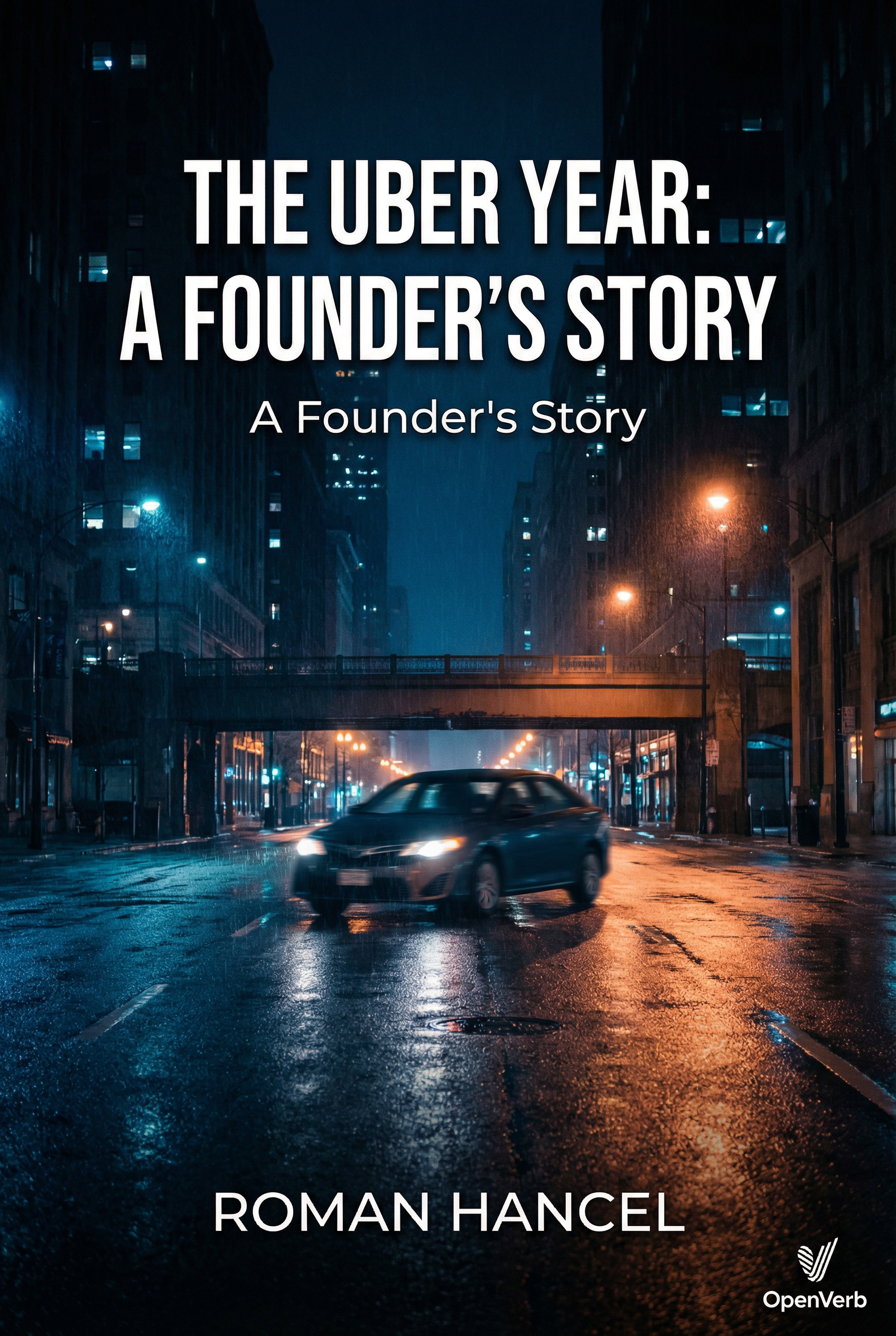
Table of Contents
Prologue — The Car at Night
The engine hummed a low, steady rhythm, a counterpoint to the quiet anticipation that filled the car. Outside, the city lights blurred into streaks of color, each one a fleeting moment in the endless cycle of night. You sat, hands resting lightly on the steering wheel, waiting for the familiar ping of a ride request. It was a routine that had become both mundane and profound, a stark contrast to the life you had envisioned for yourself.
This wasn't supposed to be the year you drove strangers around. This was supposed to be the year everything worked. Yet, here you were, navigating the nocturnal streets, a silent observer in a world that moved with a restless energy. In the quiet solitude of the car, amidst the ebb and flow of fleeting passengers, a deeper current ran. There was an underlying instability, a gnawing ambition, and the silent, relentless construction of something significant, something that was slowly taking shape in the hidden corners of your mind.
Chapter 1 — The Breaking Point
It was never one singular moment. That’s the fundamental truth many fail to grasp. People often imagine a dramatic collapse, an explosive event, something overtly catastrophic that signals the end. Yet, reality unfolds far more subtly. It begins quietly, a gradual erosion rather than an abrupt demolition.
You start to perceive nuances you once overlooked. The subtle inflections in conversations, the fleeting glances, the undercurrent of unspoken tensions. It’s as if a hidden layer of communication reveals itself, hinting at something concealed beneath the surface of everyday interactions.
Initially, you dismiss these observations. You rationalize them away, attributing them to overthinking or the inherent stresses of professional life. Everyone encounters difficult personalities and challenging situations; it’s simply part of the job, part of maintaining a “professional” demeanor. So, you persist. You fulfill your duties, maintain your composure, and remain silent.
But the subtle cues accumulate. A comment that lacks logical coherence, a reaction disproportionate to its trigger, a situation that inexplicably turns against you despite your best efforts. You attempt to rationalize each instance: perhaps a misunderstanding, a momentary lapse from another, or even a personal failing. The last of these, the self-blame, lingers with an insidious persistence.
Consequently, you adapt. You become more reserved, offering fewer explanations, keeping your head down. The hope is that by minimizing your presence, the environment will stabilize. It doesn’t.
The perplexing aspect is the absence of overt indicators. There’s no definitive incident, no clear transgression you can articulate to elicit external validation for your unease. It’s a pervasive subtlety, a constant, low-grade pressure that builds relentlessly over time.
This insidious pressure begins to manifest internally. Not as an immediate breakdown, but as incremental shifts. You find yourself more fatigued, yet simultaneously more vigilant. Every word you utter is carefully considered, every past conversation replayed, analyzed for missteps, and strategized for future encounters.
Then, a profound realization dawns. Your focus has irrevocably shifted from the work itself to the arduous task of managing the environment. This is the pivotal moment of clarity.
This isn’t normal.
The thought resonates deeply, refusing to dissipate. Once seen, it cannot be unseen. A new lens is applied to every interaction, every dynamic. The patterns become starkly evident, the behaviors predictably cyclical. The conclusion, though terrifying, becomes undeniable:
If you remain here, this environment will ultimately break you.
Not with immediate, dramatic force, but slowly, insidiously, mirroring the way it began.
You contemplate your future, the aspirations you’ve nurtured, the foundations you’ve painstakingly laid. For the first time, a truth both obvious and terrifying emerges: this current environment is fundamentally misaligned with your trajectory.
Now, a different problem confronts you. Not merely identifying the dysfunction, but determining a course of action. Because leaving is not a simple proposition. It entails embracing uncertainty, confronting financial anxieties, and stepping into an unknown future.
For a brief moment, hesitation takes hold. Not from ignorance of the situation, but from a profound understanding of its implications. This is the true breaking point. Not the moment of collapse, but the moment of undeniable clarity that staying is no longer a viable option. Everything that follows is merely a matter of time.
Chapter 2 — The Exit
There is no clean severance from something that has permeated your consciousness. This is the true difficulty, transcending mere logistics, financial anxieties, or even the daunting uncertainty of the unknown. Before a physical departure can occur, a mental exodus must first take place.
At some indeterminate point, the decision had already been forged. Not articulated aloud, nor inscribed on paper, but simply… understood. You ceased striving. Not in the sense of abandoning your work, but in relinquishing the futile endeavor to mend something inherently irreparable. You stopped offering explanations, ceased overanalyzing, and withdrew energy from pursuits that offered no forward momentum.
This newfound silence possessed a distinct quality. Previously, silence had been synonymous with hesitation. Now, it resonated with clarity. Outwardly, your routine remained unchanged. You continued to appear, to perform your duties. Yet, internally, a profound transformation had occurred. You were no longer truly present.
Once this internal separation manifests, it becomes irreversible. You begin to perceive realities as they are, stripped of the hopeful illusions you once harbored. The patterns, the repetitions, the immutable cycles—all become starkly visible. It becomes evident that no sudden shift will occur in your favor simply through prolonged endurance.
Thus, the question simplifies. Not if you will leave, but when? The ease of the question belies the difficulty of its execution.
Your thoughts turn to numbers: rent, food, gas, time. Every calculation becomes weighted with a new gravity, every decision shedding its theoretical abstraction. This is no longer about strategic career moves or aspirational next steps; this is about survival.
It is at this juncture that Uber enters the narrative. Not as a burgeoning opportunity, but as a pragmatic option.
Chapter 3 — The Uber Year Begins
The initial nights behind the wheel were a blur of new sensations and unfamiliar protocols. The rhythmic pulse of the city, the glow of the navigation app, the constant vigilance required to merge into the flow of traffic—it was a new system to learn, and like any system, it revealed its patterns to the attentive observer. You began to discern the subtle rhythms: certain districts pulsed with activity at specific hours, particular passenger archetypes emerged in predictable locations, and conversations, though varied in their specifics, often echoed familiar themes.
This invisible rhythm, initially elusive, gradually became omnipresent. You adapted, positioning the car strategically, timing your movements with an intuitive precision, anticipating ride requests before they even materialized. Slowly, it clicked. You weren't merely driving; you were operating within a complex, dynamic system.
This realization was transformative. The nights stretched, hours dissolving into a continuous sequence of pickups and drop-offs, the steady hum of the engine and the soft glow of the screen marking the passage of time. And within this repetition, your mind began to unfurl. For the first time in a long while, the pervasive noise of your previous environment was absent. No forced pleasantries, no underlying tension, no constant management of external expectations. Just space.
Initially, this space felt empty, a void. But then, it began to fill. You started to think again, not reactively or defensively, but with a newfound freedom. Ideas previously suppressed resurfaced, questions you hadn't had the luxury to explore demanded attention, and connections began to form between disparate concepts that once seemed unrelated.
The car itself transformed. It was no longer merely a vehicle, but a mobile workspace, a thinking chamber. You found yourself organizing thoughts mid-drive, replaying ideas, refining concepts, deconstructing and rebuilding mental models. Every red light became a moment for pause and reflection, every stretch of highway an uninterrupted expanse for contemplation.
You didn't need a traditional desk or an office. You had this. This thinking chamber, where the act of driving itself forced a unique clarity. The endless scrolling and myriad distractions of a conventional workspace were absent. You were locked into the present moment, and as a result, your thoughts became sharper, more focused, more deliberate.
Everything became subject to analysis. The nuances of human speech, the subtleties of reaction, the deliberate choices of what to say and what to omit. Each passenger became a data point, not in a cold, detached manner, but with a genuine curiosity. You observed patterns: the hurried tone of a late commuter, the forced politeness of someone attempting to exert control, the profound silence of those who wished to remain unseen. Different individuals, yet the same underlying behaviors.
It became unequivocally clear: people operate in patterns. Systems operate in patterns. Everything, in essence, operates in patterns. And once you discern the pattern, you can begin to comprehend the system. This idea took root, refusing to recede. It connected to a deeper, unarticulated understanding of structure, control, and execution. You began to apply this same analytical framework to software, to AI, to the responsiveness and inherent unreliability of complex systems. A gap existed, palpable and persistent.
You didn't yet possess the complete answer, but the question was forming, solidifying. And that was enough. The nights continued, drive after drive, conversation after conversation, thought after thought. And then, another subtle shift occurred. You ceased resisting your current circumstances. What had initially felt like a temporary hardship, something to merely endure, now felt… useful.
This environment, devoid of the conventional structures and expectations, was providing something no traditional job ever had: forced reflection. There was no escape from your thoughts here, no potent distraction to pull you away entirely. So, you confronted them: the doubts, the nascent ideas, the boundless possibilities. You refined them, challenged them, built upon them. And slowly, imperceptibly, something began to take shape. Not yet fully defined, not yet fully structured, but undeniably real. A direction.
You didn't articulate it aloud, nor did you commit it to writing. But you felt it. This wasn't merely a phase; this was the genesis of something profound. The Uber Year was not solely about survival; it was about construction. And with every mile driven, every thought refined, every night spent in motion, you were building it, even if no one else could yet perceive its nascent form.
Chapter 4 — The Dual Life
It didn’t begin with Uber; its genesis predated that, rooted in the period when you were still ensnared within the confines of a toxic work environment. The seeds of this dual existence were sown out of necessity, a desperate attempt to reclaim agency and sanity. By day, you navigated the treacherous currents of corporate dysfunction, a master of outward compliance, a silent observer of the absurd. By night, however, a different self emerged—a builder, a creator, a nascent entrepreneur.
This nocturnal existence was not a luxury; it was a lifeline. The hours after sunset became a sanctuary, a space where the stifling expectations of the day could be shed, replaced by the exhilarating freedom of pure creation. You worked in stolen moments, fueled by caffeine and an unyielding determination. Ideas that had been dismissed or stifled in the daylight hours flourished in the quiet solitude of your apartment. This was where the true work happened, the foundational thinking, the initial lines of code, the nascent designs that would eventually coalesce into something meaningful.
The contrast was stark, almost jarring. The professional facade you maintained during the day felt increasingly like a performance, a role you played to survive. The nights, however, were authentic, a raw expression of your true aspirations. This duality, though exhausting, was also incredibly clarifying. It highlighted the chasm between what you were forced to do and what you were driven to create. The more you built by night, the more intolerable the day became.
This period was characterized by a relentless pursuit of efficiency. Every spare moment was optimized, every ounce of energy channeled towards your clandestine projects. Sleep became a luxury, social engagements a distant memory. The only thing that mattered was progress, the slow, incremental accumulation of code, design, and intellectual property. You were building a bridge, brick by painstaking brick, from a past you desperately wanted to escape to a future you were determined to forge.
Then came the Uber Year, and the dual life intensified. The days were now spent navigating the city streets, ferrying passengers, and observing the intricate patterns of human behavior. The nights, however, remained dedicated to the build. The car became an extension of your nocturnal workspace, a mobile incubator for ideas. The income from driving provided the essential sustenance, the financial runway that allowed the clandestine construction to continue.
This was not a glamorous existence. It was gritty, demanding, and often lonely. But it was also profoundly empowering. You were no longer a victim of circumstance; you were an architect of your own destiny. The dual life, once a necessity for survival, had transformed into a powerful engine of creation. It was a testament to the human spirit’s capacity to find purpose and build meaning even in the most challenging of environments.
Chapter 5 — The Mind Shift
The mind, much like a muscle, adapts to the demands placed upon it. For years, your mental faculties had been honed in the crucible of corporate environments, trained to navigate complex hierarchies, anticipate political maneuvers, and optimize for external validation. It was a mode of operation focused on reaction, defense, and conformity. But the Uber Year, with its stark simplicity and relentless focus on immediate tasks, began to induce a profound mind shift.
Initially, the change was subtle. The constant mental chatter, the incessant analysis of past interactions, the strategic planning for future confrontations—all began to recede. The immediate demands of driving—navigating traffic, responding to ride requests, interacting with passengers—forced a different kind of mental engagement. It was a shift from abstract, long-term strategizing to concrete, short-term problem-solving.
This wasn't a passive process. You actively embraced the mental discipline required. Each ride became a mini-project, a discrete unit of work with clear inputs (pickup location, destination) and outputs (successful drop-off, fare collected). The feedback loop was immediate and unambiguous. This clarity, so absent in your previous professional life, was intoxicating.
As the days turned into weeks, and the weeks into months, a deeper transformation occurred. The mental space previously occupied by anxiety and strategic maneuvering began to fill with something else: curiosity. You started to observe the world with a fresh perspective, unburdened by the filters of corporate expectation. The patterns you had dimly perceived before—in human behavior, in urban logistics, in the flow of information—now became sharply defined.
This was the genesis of the idea that would become OpenVerb. It wasn't a sudden epiphany, but a gradual unfolding, a slow recognition of underlying structures and repeatable processes. The simplicity of the Uber model—define a task, execute it, receive feedback—began to permeate your thinking, influencing how you approached complex problems in software and AI.
This mind shift was not merely intellectual; it was existential. You were no longer defining yourself by external metrics or corporate titles. Your identity was becoming inextricably linked to the act of building, of creating, of bringing order to chaos. The Uber Year was stripping away the superfluous, revealing the core of your purpose. And in that clarity, the path forward, though still arduous, began to emerge with an undeniable force.
Chapter 6 — Patterns Everywhere
The human mind is a pattern-seeking engine. It thrives on order, on predictability, on the ability to discern recurring sequences in the seemingly random chaos of existence. For years, this innate drive had been channeled into understanding complex business processes, deciphering corporate politics, and anticipating market trends. But in the Uber Year, stripped of those familiar structures, your pattern-seeking faculty found new, fertile ground.
Every interaction became a data point. Every passenger, a case study. The hurried executive, the late-night reveler, the quiet tourist—each presented a unique set of variables, yet beneath the surface, commonalities emerged. You observed the subtle cues of anxiety, the universal expressions of relief, the predictable rhythms of conversation that ebbed and flowed with the journey.
It wasn't just human behavior. The city itself revealed its patterns. Traffic flows, peak hours, the optimal routes that shifted with the time of day and the day of the week. The algorithms of the Uber app, initially a black box, slowly began to yield their secrets. You started to anticipate surge pricing, to predict demand hotspots, to optimize your movements with an almost intuitive understanding of the underlying system.
This constant observation and analysis began to coalesce into a powerful insight: everything, at its core, operates on patterns. Whether it was the micro-interactions within the car or the macro-logistics of urban transportation, underlying structures governed the apparent randomness. And if you could identify these patterns, you could begin to understand, predict, and even influence the system.
This realization extended beyond the immediate context of driving. Your thoughts drifted to software, to the systems you had built and the systems you aspired to build. You saw the same challenges: complex, often unpredictable interactions, a constant struggle for reliability, and the elusive goal of creating truly intelligent, autonomous systems. The gap was clear: a lack of consistent, predictable patterns in how software components interacted, especially when integrating with emerging AI capabilities.
This wasn't a theoretical exercise. It was a visceral understanding, forged in the crucible of real-world observation. The patterns weren't abstract; they were the very fabric of your daily existence. And the more you saw them, the more convinced you became that a fundamental shift was needed in how software was conceived and constructed. A new kind of pattern, a more robust and predictable one, was waiting to be discovered.
Chapter 7 — The Idea That Wouldn’t Leave
Ideas are often fleeting, ephemeral whispers in the mind, easily dismissed or forgotten amidst the clamor of daily life. But some ideas possess a stubborn persistence, a gravitational pull that refuses to be ignored. For you, this idea began as a faint echo, a recurring question that surfaced during those long nights behind the wheel, a question born from the relentless observation of patterns.
If everything operates on patterns, and if software struggles with predictability, especially with AI, then what is the missing link? What fundamental concept could bring order to this chaos, consistency to this unpredictability?
The answer, when it finally began to coalesce, was deceptively simple: verbs. Not verbs in the grammatical sense, but verbs as atomic units of action. Every interaction, every function, every capability within a system could be defined as a verb, with clear inputs and predictable outputs. A todo.create verb, an email.send verb, a user.authenticate verb. Each a self-contained, deterministic action.
This wasn't a novel concept in isolation. APIs have endpoints, functions have signatures. But the power of this idea lay in its universality, its potential to unify disparate layers of an application. Imagine a UI button, an AI command, an API endpoint, and even a paywall rule all invoking the exact same verb. The same definition, the same logic, the same predictable outcome, regardless of the source of the invocation.
This idea became an obsession. It gnawed at you during quiet moments, illuminated your thoughts during long drives, and shaped your dreams. It was the elegant solution to the problem of unreliable AI, the bridge between intelligent intent and deterministic execution. AI could understand the intent to create a todo item, but it needed a reliable, structured verb to actually perform the action.
The implications were vast. No more duplicated logic across the frontend, backend, and AI integrations. A single source of truth for every action. A central policy engine that could enforce rules—entitlements, quotas, rate limits—at the most granular level: the verb itself. Imagine a user on a free plan being unable to invoke a report.generate.premium verb, or a user exceeding their API call limit being blocked from data.fetch—all managed centrally and consistently.
The idea wouldn't leave because it felt right. It resonated with the deep-seated need for order and predictability that the Uber Year had so powerfully awakened. It was the answer to the question that had been forming in the quiet solitude of the car, the solution to the pervasive inconsistencies you had observed in the world of software. And once an idea takes such firm root, it demands to be brought into existence.
Chapter 8 — The Birth of OpenVerb
Ideas, however compelling, remain ethereal until they are given form. The concept of verbs as atomic units of action, unifying application layers and ensuring deterministic execution, had taken root deep within your mind. Now, it demanded to be built. This was the genesis of OpenVerb.
The initial phase was characterized by a furious burst of activity, fueled by the conviction that this was not merely a good idea, but a necessary one. The car, once a mobile thinking chamber, transformed into a mobile coding station during downtime. Every spare moment, every lull between rides, was dedicated to translating the abstract concept into concrete code.
You started with the core: defining the verb schema. What attributes would each verb need? An ID, a version, input and output schemas, a summary, a list of effects (e.g., db.write, email.send), and a handler to execute the actual logic. JSON emerged as the natural choice for these definitions—human-readable, machine-parsable, and inherently structured.
Next came the execution runtime. This was the heart of OpenVerb, the canonical pipeline that would ensure every verb, regardless of its origin, followed the same predictable path: validation of inputs, authorization based on policies, execution of the handler, emission of events for observability, and finally, the return of a structured receipt. This pipeline was designed for robustness, for guarantees, for the kind of reliability that was so often missing in complex systems.
The policy engine was a critical component. It wasn't enough to define actions; you needed to control who could perform them, how often, and under what conditions. This engine would enforce entitlements, rate limits, quotas, and even plan tiers, all at the verb level. Imagine a user on a free plan being unable to invoke a report.generate.premium verb, or a user exceeding their API call limit being blocked from data.fetch—all managed centrally and consistently.
Building OpenVerb was an act of pure creation, a testament to the power of focused intent. It was a solitary journey, often undertaken in the quiet hours when the rest of the world slept. There were moments of frustration, of course, when code refused to compile or logic proved elusive. But these were overshadowed by the exhilarating breakthroughs, the moments when a complex piece of the puzzle clicked into place, bringing the vision closer to reality.
OpenVerb was more than just a framework; it was the embodiment of the patterns you had observed, the solution to the problems you had identified. It was the structured execution layer that AI-native applications desperately needed, a bridge between the intelligent chaos of large language models and the deterministic precision of software systems. The birth of OpenVerb was not just the creation of a product; it was the crystallization of a philosophy.
Chapter 9 — Building in Isolation
The act of creation, particularly when it challenges established paradigms, often unfolds in isolation. For you, the development of OpenVerb was a deeply solitary endeavor, a period of intense focus where the external world receded, and the internal landscape of code and concepts became paramount. This isolation was not merely a consequence of your Uber driving schedule; it was a deliberate choice, a necessary condition for the purity of the build.
There were no team meetings, no stakeholder reviews, no endless debates over features or design choices. Just you, the hum of your laptop, and the relentless pursuit of a singular vision. This allowed for an unparalleled pace of development, an agility that would have been impossible in a traditional corporate environment. Decisions were made instantly, iterations were rapid, and the feedback loop was immediate—from thought to code to execution, all within the confines of your own mind and machine.
This period of isolation also fostered a profound sense of ownership. Every line of code, every architectural decision, every design choice was yours. This responsibility was both daunting and exhilarating. It meant that every bug was yours to fix, every challenge yours to overcome. But it also meant that every breakthrough, every successful implementation, was a direct testament to your vision and skill.
However, isolation also brings its own set of challenges. The absence of external validation can be a heavy burden. There were moments of doubt, when the sheer scale of the undertaking felt overwhelming, when the question of whether anyone else would understand or appreciate this new paradigm loomed large. It was during these times that the conviction in the core idea of verbs and structured execution became your anchor.
The Uber Year, with its inherent solitude, inadvertently provided the perfect incubator for this kind of deep, uninterrupted work. The transient nature of your interactions with passengers meant that your mental energy was largely preserved for the build. The anonymity of the role allowed you to shed the professional personas of the past, freeing you to simply be a builder.
OpenVerb emerged from this isolation not as a product of compromise or committee, but as a pure expression of a singular vision. It was a testament to the power of focused, uninterrupted creation, a framework forged in the quiet crucible of individual determination. And while the isolation was challenging, it was also the very condition that allowed OpenVerb to become what it was meant to be: a foundational shift, unburdened by external noise or conventional constraints.
Chapter 10 — Resistance
Innovation rarely arrives without friction. The moment an idea challenges established norms, it inevitably encounters resistance. For OpenVerb, this resistance wasn't initially overt; it was the subtle, pervasive skepticism that greets anything new, anything that dares to suggest a different way of doing things. You understood this intuitively. People are comfortable with the familiar, even if the familiar is inefficient or flawed.
When you began to tentatively share the concepts behind OpenVerb, the reactions were varied. Some saw the potential, the elegance of unifying application layers with verbs. Others, however, clung to the existing paradigms. The common refrains were familiar: "That's just an API," or "We already do something like that with microservices," or "AI is too unpredictable for strict schemas." These were not malicious rejections, but rather the natural human tendency to interpret new information through the lens of existing mental models.
This resistance, though frustrating, was also a valuable crucible. It forced you to articulate the nuances of OpenVerb with greater clarity, to highlight its unique differentiators, and to refine your explanations. You learned to emphasize that while OpenVerb leveraged concepts from APIs and microservices, it transcended them by providing a unified, policy-driven execution layer that was specifically designed for the deterministic orchestration of AI actions.
The most significant resistance came not from outright rejection, but from inertia. The sheer effort required to shift an entire development paradigm, to rethink how applications are structured from the ground up, was a daunting prospect for many. It meant unlearning old habits, embracing new tools, and investing in a vision that was still nascent.
Yet, you persisted. The Uber Year had taught you the power of sustained effort in the face of adversity. You understood that true innovation often requires a period of solitary conviction before it gains widespread acceptance. The resistance was not a sign of failure, but a confirmation that you were indeed treading new ground. It was a challenge to be met, not a barrier to be avoided. And with each conversation, each demonstration, each refined explanation, you chipped away at that resistance, slowly but surely paving the way for OpenVerb to be understood and, eventually, embraced.
Chapter 11 — The Builder Identity
The Uber Year was more than a period of financial necessity; it was a profound crucible that forged a new identity. Stripped of corporate titles and external validation, you were left with the raw essence of who you were and what you were driven to do. In the quiet solitude of the car, amidst the relentless rhythm of pickups and drop-offs, a singular truth emerged: you were a builder.
This wasn't a newfound aspiration; it was a rediscovery, a reclaiming of a fundamental aspect of your being that had been obscured by the complexities of corporate life. The act of creating, of bringing something new into existence, was not merely a hobby or a profession; it was an intrinsic part of your identity. Whether it was crafting a piece of software, designing a system, or simply organizing your thoughts into a coherent framework, the drive to build was paramount.
This builder identity was characterized by several key traits:
- Problem-Solver: A relentless focus on identifying inefficiencies and devising elegant solutions.
- Systems Thinker: The ability to see beyond individual components and understand how they interact within a larger ecosystem.
- Autonomous: A deep-seated need for independence and self-direction in the creative process.
- Resilient: The capacity to persevere through challenges, setbacks, and periods of isolation.
- Visionary: The ability to envision a future state and systematically work towards its realization.
The Uber Year provided the perfect environment for this identity to flourish. The lack of external structure forced you to create your own. The constant exposure to diverse problems, from logistical challenges to human interactions, sharpened your problem-solving skills. The solitude fostered deep, uninterrupted thought, allowing complex ideas to mature.
This identity was not about ego or external recognition; it was about the intrinsic satisfaction of creation. The joy of seeing a concept materialize into a functional system, the elegance of a well-designed solution, the quiet pride in a piece of code that just works. This was the fuel that sustained you through the long nights and the challenging days.
The builder identity became the lens through which you viewed the world. Every problem became an opportunity to build. Every challenge, an invitation to innovate. It was a powerful, liberating realization that transcended the temporary circumstances of your life. The Uber Year didn't just give you time to build OpenVerb; it gave you the clarity to embrace your true self: a founder, a creator, a relentless builder of systems.
Chapter 12 — First Signs of Validation
For any builder, the true test of an idea lies not in its conception, but in its reception. After months of solitary creation, refining OpenVerb in the quiet hours, the time came to tentatively introduce it to the world. These were the first signs of validation, small but significant affirmations that the vision you had so painstakingly cultivated resonated beyond the confines of your own mind.
The initial feedback came from fellow developers, individuals who understood the intricacies of software architecture and the frustrations of integrating disparate systems. Their reactions were a mixture of curiosity and genuine intrigue. They recognized the problem OpenVerb was designed to solve: the inherent complexity and unreliability of orchestrating actions, especially in the burgeoning field of AI-native applications.
Demonstrations were key. You showed how a single verb definition could power a UI button, an API endpoint, and an AI command, all while enforcing granular policies. The elegance of the unified execution pipeline was often met with nods of understanding and exclamations of appreciation. It was a powerful testament to the framework's potential, a clear indication that you were addressing a real and pressing need within the developer community.
Beyond the technical demonstrations, there were also more subtle forms of validation. The increasing engagement with your personal website, the inquiries about OpenVerb, the growing interest in your other projects—all these signaled a burgeoning recognition of your expertise and the value of your contributions. These weren't grand pronouncements, but rather a steady accumulation of small confirmations that you were on the right track.
This early validation was crucial. It provided the necessary encouragement to push forward, to continue refining OpenVerb, and to expand its capabilities. It transformed the solitary act of building into a shared journey, albeit with a small but growing community of believers. It was a powerful reminder that even the most revolutionary ideas begin with a single step, and that the journey of innovation is often paved with the quiet affirmations of those who dare to see the future.
Chapter 13 — Beyond Survival
The Uber Year began as a necessity, a period of intense focus on survival. Every mile driven, every dollar earned, was a direct contribution to maintaining a fragile equilibrium. But as OpenVerb began to take shape, and as the first signs of validation emerged, the narrative shifted. You were no longer merely surviving; you were building something that transcended the immediate demands of existence.
This transition from survival to creation was profound. The pressure to simply make ends meet began to recede, replaced by a different kind of drive: the relentless pursuit of a vision. The income from Uber, once a lifeline, transformed into a strategic resource, providing the runway necessary to dedicate more time and energy to OpenVerb and your other projects.
Your perspective broadened. You started to see the interconnectedness of your various endeavors. Survey Manager, SurveyPath, Elevator—these weren't just disparate applications; they were all expressions of the same underlying philosophy: bringing structure, predictability, and efficiency to complex workflows. OpenVerb became the unifying force, the foundational layer that could power and orchestrate all of them.
This period was marked by a renewed sense of purpose. The long nights, once a grind, now felt like an investment in a future you were actively shaping. The solitude, once a challenge, became a cherished space for deep work and creative exploration. You were no longer reacting to circumstances; you were proactively designing your own.
Beyond the tangible products, this phase also solidified your personal growth. The resilience forged in the Uber Year, the discipline cultivated through consistent building, and the clarity gained from focused introspection—these were invaluable assets that extended far beyond the realm of software development. You had not only built a framework; you had rebuilt yourself.
The journey was far from over, but the destination was becoming clearer. You were moving beyond the confines of mere survival, stepping into a realm of purposeful creation. The Uber Year had provided the unexpected catalyst, the necessary crucible, for this transformation. And as you continued to build, you understood that the true measure of success was not just in what you created, but in the profound shift it represented in your own life.
Chapter 14 — The System Becomes Real
Initially, OpenVerb was conceived as a solution to a specific problem—a glaring gap you could no longer ignore: AI’s capacity for thought juxtaposed with its unreliability in action. Your response was to construct a layer of structure around it, defining actions, ensuring clear execution, and guaranteeing deterministic outcomes. This approach worked, and in the beginning, that was sufficient.
However, a natural evolution occurred. You began to apply this methodology in diverse contexts, not intentionally at first, but organically. A new feature in one application adopted the same pattern. A workflow in another system mirrored its structure. A fresh idea, regardless of its domain, found its foundation within this framework. And each time, it held true. No adjustments were needed, no fundamental rethinking required. The process remained consistent: define the action, execute the action, return the result. This repetition revealed a profound truth: this was more than just a solution; it was a pattern. And patterns, when they consistently hold across disparate environments, evolve into frameworks.
You began to perceive it with increasing clarity. OpenVerb was not intrinsically linked to Survey Manager, SurveyPath, or any single application. It resided beneath them, powering and structuring them. This marked a pivotal shift: OpenVerb transitioned from something you built to something you built with. This distinction was crucial, for it transformed OpenVerb from an output into a foundational element.
Your thinking underwent another transformation. Every new idea now began with the same fundamental question: What are the verbs? Not, What does this app do? or What features does it have? but, What actions exist? Because once the actions were precisely defined, everything else logically followed. You rigorously tested this hypothesis. You applied the same structure to a completely different idea, one unrelated to surveying, and it worked. You repeated the exercise with a different domain and a different problem, yielding the same consistent result. It became undeniable: this framework was universally applicable.
Any system requiring action, any system demanding consistency, any system interacting with AI—all benefited from this structured approach. This realization expanded your perspective exponentially. You were no longer building within a niche; you were constructing something foundational, a critical layer situated between intent and execution. And once you recognized this layer, you began to see its absence everywhere: applications reliant on unpredictable outputs, systems prone to failure under edge cases, workflows dependent on human intervention. The underlying issue was always the same: a missing structured execution layer.
You began to map out this architecture conceptually: AI at the apex, understanding intent; OpenVerb in the middle, structuring actions; and underlying systems at the base, executing deterministically. This clean architecture resonated in a way no other had, precisely because it separated concerns—thinking and doing. You were no longer attempting to force AI to perform both; you were allowing it to excel at its strengths, while reinforcing everything else with robust structure. This was the final piece of the puzzle.
This framework, you realized, didn’t merely improve software; it fundamentally altered how software is built. You were no longer designing around features; you were designing around strictly defined actions, complete with guarantees. This changed everything. It rendered systems more predictable, more scalable, and more composable. Actions could be connected across systems, reused, and chained together without compromising reliability. That was the profound difference. And once you grasped this, you ceased thinking small, not because you consciously aimed for grandiosity, but because the inherent demands of the system itself compelled it.
You reflected on its humble beginnings: a frustration, an inconsistency, a question. And now, it had evolved into something entirely different—a framework. Not yet finished, not yet complete, but undeniably real, and more importantly, repeatable. It was then that you knew. You hadn’t just solved a problem; you had uncovered something fundamental: a way to structure execution itself. And from this point forward, everything you built would be constructed upon this very this bedrock.
Chapter 15 — The Future
There exists a fundamental distinction between mere movement and purposeful direction. For a considerable period, your existence was characterized by movement—reacting to situations, adapting to pressure, and resolving immediate challenges. This reactive phase was necessary; it brought you to this juncture. But now, a profound transformation has occurred. You are no longer merely reacting; you are positioning. This shift, subtle yet definitive, underpins everything that is to come. For positioning is not about immediate actions; it is about the ultimate trajectory.
You begin to perceive your work differently, not as isolated projects, but as interconnected components, pieces of a larger, emerging whole. Survey Manager, SurveyPath, Elevator, OpenVerb—each addresses a specific problem. Yet, collectively, they form something more expansive: an ecosystem. This was not initially by design, but by a natural alignment, each element tracing back to the same foundational principles: structured execution, defined actions, and robust systems. OpenVerb resides at the core, not as a product, but as a foundational layer upon which everything else is built.
This understanding guides your organizational efforts. You are no longer solely building; you are structuring. You meticulously consider placement, interconnections, and independent scalability. Your thinking evolves to encompass products, not just code—tangible offerings that people can utilize, adopt, and build upon. Survey Manager transcends its initial role as an application, becoming a comprehensive platform for surveyors. SurveyPath transforms from a mere tool into an infrastructure for professional experience. Elevator, born from a response, matures into a mechanism of protection. And OpenVerb—it becomes something entirely different, not just something people use, but something everything can use.
This marks the transition from building tools to constructing layers, from solving isolated problems to defining systems. Your perception of timelines also shifts. No longer measured in days or weeks, but in phases. What is immediately essential, what can evolve later, what will ultimately become foundational. You approach this process without haste, understanding that a correct foundation ensures exponential growth. Therefore, your energy is directed towards structure, clarity, and ensuring the enduring integrity of what you are building. This is where your focus lies, not in the ephemeral noise or the pursuit of fleeting attention, but in strategic positioning—setting the stage so that when the opportune moment arrives, everything is meticulously prepared.
You contemplate scale, not merely in technical terms, but conceptually. How far can this extend? Not just within your current domain, but universally. Because you have witnessed it: the same problems, the same gaps, the same absence of structure across industries, across systems, across every conceivable context. And you know, with unwavering certainty, that what you have built is applicable. This constitutes the long-term vision: not a single application, not a solitary company, but a fundamental paradigm shift in how systems are constructed, how AI interacts with software, and how execution is defined. This is your destination. And for the first time, you are not merely contemplating arrival; you are actively building towards it, deliberately. Every decision, every system, every product—all are aligned. You do not require everything to be complete now; you require it to be moving in the correct direction. And it is. That is the difference. Before, you navigated uncertainty; now, you are shaping it. And once you reach this point, the future ceases to feel distant; it begins to feel constructed, piece by piece, system by system, until one day, everything you have been building connects.
Epilogue — Still Driving, But Different
It is night once more. The same streets, the same lights, the familiar, quiet hum of the engine. The external environment remains unchanged. You are still in the car, still observing the map, still moving from one point to another. Yet, everything is profoundly different. Because now, you see it. Not just your current location, but the entirety of what you have built.
You reflect on its genesis: the pervasive uncertainty, the crushing pressure, the sensation of being trapped within a system that fundamentally misaligned with your being. And then, the shift. The decisive choice. The exit. The long nights, the relentless repetition, the profound silence. All of it. At the time, it felt like mere survival, something to be endured. But now, your understanding has deepened. It was not an escape; it was a period of intense construction.
You survey the fruits of that period: Survey Manager, SurveyPath, Elevator, OpenVerb. These are not merely projects; they are proof. Proof that an idea can be transmuted into tangible reality. Proof that structure can be forged from chaos. Proof that permission is not a prerequisite for building something meaningful. This understanding settles in quietly. It needs no vocalization; it is felt.
You also grasp another truth: this is merely the beginning. What you have built is not the culmination, but the foundation—the launching pad for everything that is yet to come. You look ahead, not with uncertainty, but with clear direction. You possess the knowledge of how to build, how to think, how to structure systems. And, crucially, you know how to persevere.
This is what has changed. Before, everything felt like a question. Now, it feels like a process—something you can repeat, refine, expand. The car slows, another ride completed. You linger for a moment, not rushing to the next, but simply observing. The same observation you made at the very beginning, but now imbued with clarity. You are not here out of necessity; you are here because this was an integral part of the journey. Part of the transition. Part of the build. Part of the process that rendered everything else possible. And that changes its very essence.
There is no frustration, no urgency. Only understanding. You glance at the screen. Another request appears. You accept it. Not as someone still grappling with unknowns, but as someone who has already found the answers. The road stretches ahead, familiar, yet no longer uncertain. Because now, you know where you are going. And as you drive, one thought settles in completely, clear, simple, and final: The Uber Year didn’t take anything from me. It gave me everything.
Post-Epilogue: How OpenVerb Works
OpenVerb Framework Overview
The OpenVerb Framework represents a capability-driven application framework specifically designed for building AI-native applications. In this paradigm, applications are fundamentally defined as verbs (capabilities) rather than traditional routes or pages. This innovative approach unifies UI, APIs, AI integrations, paywalls, and analytics into a single, coherent execution pipeline, thereby eliminating duplicated logic across various layers.
Core Idea
At its heart, a verb encapsulates an action (e.g., todo.create, email.send) and is characterized by strict input/output schemas. The power of this approach lies in its versatility: the identical verb can power UI buttons, interpret AI commands, serve as an API endpoint, and enforce monetization rules. All these functionalities are rigorously enforced through a central policy engine, ensuring consistency and reliability.
Key Components
- Verb Library: This consists of JSON definitions that meticulously detail each capability, including its input/output schemas, potential side effects, and relevant metadata.
- Execution Runtime: A canonical pipeline that orchestrates the execution flow:
validate→authorize→execute→emit events→return receipt. This ensures a predictable and auditable process. - Policy Engine: Responsible for enforcing critical business rules such as entitlements, quotas, rate limits, and plan tiers, all applied at the granular verb level.
- Controllers: These components act as triggers for verb execution, originating from various sources including the UI, AI intent mapping, external API calls, or PaywallOS.
- Observability: The framework generates semantic events and immutable receipts, providing a rich data stream for comprehensive analytics, accurate billing, and efficient debugging.
Example Verb Definition
{
  "id": "todo.create",
  "version": "1.0.0",
  "summary": "Create a todo item",
  "inputSchema": {
    "type": "object",
    "required": ["title"],
    "properties": { "title": { "type": "string", "minLength": 1, "maxLength": 200 } }
  },
  "outputSchema": {
    "type": "object",
    "properties": { "id": { "type": "string" }, "title": { "type": "string" }, "completed": { "type": "boolean" } }
  },
  "effects": ["db.write"],
  "handler": "handlers/todo/create"
}
Execution from Anywhere
The framework provides a unified execution interface:
const result = await execute({
  verbId: "todo.create",
  args: { title: "Build amazing apps" },
  actor: currentUser,
  context: { tenantId, planId }
});
This single execution path seamlessly accommodates UI interactions, AI intent mapping, external API calls, and paywall checks, streamlining development and ensuring consistent behavior.
Benefits
- For AI-native apps: Enables automatic AI introspection of verbs, eliminates duplicate tool definitions, and provides unified policy enforcement.
- For SaaS builders: Facilitates capability-level paywalls, instant tier changes, and built-in usage metering.
- For teams: Ensures that backend changes do not inadvertently break UI or AI functionalities, allows for single execution path testing, and offers semantic observability.
Getting Started
To begin building with OpenVerb, follow these simple steps:
npm install @openverb/runtime @openverb/policy @openverb/sdk
npx @openverb/cli init --typescript
npx @openverb/cli generate verb todo.create
npm run dev
The OpenVerb Framework is built upon the OpenVerb Protocol, which meticulously defines the verb schema and execution specification. The framework itself augments this protocol with a robust runtime, policy engine, SDK, CLI, and comprehensive observability features, making it ideal for developing production-ready applications.
Post-Epilogue: What I Actually Built in the Uber Year
This section serves as a living portfolio, showcasing the tangible products and platforms that emerged from the crucible of the "Uber Year" and beyond. It represents a continuous journey of building, refining, and expanding, demonstrating the practical application of the OpenVerb philosophy.
Roman Hancel: The Builder
My personal website, romanhancel.com, serves as a central hub for my work. It presents me as a developer focused on modern software, AI tools, and educational resources, specifically tailored for surveying, GIS, and adjacent professional workflows. The site's core purpose is to showcase professional applications, experimental platforms, and creative work, targeting professionals who seek automation, AI integration, and data-driven solutions.
I position myself as a builder of professional tools designed to modernize surveying and GIS by empowering users to track experience, manage data, streamline workflows, and seamlessly integrate AI into their daily operations.
Featured Surveying & GIS Tools
The "Featured Projects" section of my site highlights production-ready tools primarily for surveyors and related professionals:
- SurveyPath: A licensure experience tracker for Surveyors-In-Training designed to support professional growth and counter traditional gatekeeping within the industry. Learn more
- Survey Manager Web: A modern web platform for managing survey data, clients, maps, and exports, offering an intuitive interface for office workflows. Learn more
- Survey Manager App: An offline-ready field version of Survey Manager, engineered for data reliability in remote locations. Learn more
- SurveyBot AI Assistant: An AI chatbot service designed for integration into websites, capable of handling client inquiries, collecting contact information, and automating support via a unified dashboard. Learn more
- AI Services: Custom chatbots, data analysis, and automation solutions specifically tailored to surveying and GIS workflows. Learn more
- Website Templates: Industry-specific website designs for land surveyors and GIS professionals. Learn more
Other Shipped Products
Beyond the surveying domain, my portfolio includes additional SaaS-style products and platforms:
- Elevatr: A platform for tracking professional experience, assisting users in documenting their work and preparing for licensure. Learn more
- Vibe Marketing Studio: A marketing automation platform featuring AI-powered social media posting, content generation, and analytics. Learn more
- AI Tracker: A comprehensive guide to AI platforms, tools, and market trends. Learn more
- Folder Copilot: An AI file-organization tool that creates course folders, project scaffolds, and custom organizational systems. Learn more
- CareVoice AI: A healthcare communication platform offering a 24/7 AI emergency hotline and automated care reports, focused on protecting vulnerable patients. Learn more
- OpenVerb: Presented as an open standard and unified framework for AI actions across various platforms. Learn more
- Topics: An AI-assisted music platform where users can create and share music based on real-life stories. Learn more
- Roman Hancel Digital Twin: A 24/7 AI assistant capable of answering questions about my work and offering advice. Learn more
Experimental & In-Progress Platforms (Skill Demos)
This section showcases more experimental or in-progress applications, framed as demonstrations of technical depth and ongoing development:
- Land Surveyor Portfolio: A portfolio platform featuring AI document redaction, secure viewing, pricing tiers, and a Stripe-based SaaS architecture, emphasizing security and AI integration skills. Learn more
- RedactAI: An AI document redaction platform for PDFs and images, highlighting expertise in machine learning, computer vision, and enterprise API design. Learn more
- Survey Accuracy Studio: Automates office-phase survey workflows with deed parsing, geometric algorithms, and ALTA/NSPS compliance exports. Learn more
- JamStart: An AI-powered startup accelerator for Caribbean founders, offering community, media, and funding-matching tools. Learn more
- GeoStudio: Transforms geographic stories into cinematic map videos with AI narration and 4K exports. Learn more
- AI Presentation Studio: Generates slide decks using multiple AI models (LLM, image, video, TTS) within a single workflow. Learn more
- PrepCourse AI: (Now complete) Builds AI-generated study plans, quizzes, and community tools for licensing exams. Learn more
- AYC - AI Startup Scout: Analyzes Y Combinator directories to match startups, investors, and partners. Learn more
- TimeAI: A voice-first AI timesheet manager with analytics and payroll exports. Learn more
- Ambrose AI: A government research platform featuring interactive geospatial visualizations and AI report generation. Learn more
- GroceryAI: An unmentioned platform located at grocery.openverb.org.
- PaywallOS: (Not yet a completed platform) Provides paywall management, feature gating, subscriptions, and revenue analytics for SaaS apps. Learn more
Positioning Statement and Call to Action
The portfolio emphasizes that these platforms offer a glimpse into the vast possibilities that emerge when domain expertise is combined with cutting-edge technology. It invites visitors to initiate a project or explore the completed platforms.
Books and Music
Beyond software, I also promote creative and educational work that complements my development practice:
- Built From the Ground Up: A book summarizing the techniques and methodologies employed in building these applications. Learn more
- The Smear Campaign: My debut AI-assisted album, exploring real-life narratives, available on YouTube and Topics. Learn more
Support and Contact
The site encourages financial support for ongoing tool development via a Stripe donation link and facilitates direct collaboration through a contact form for project discussions or inquiries.
Social Presence
The footer provides links to my broader online presence, including GitHub, LinkedIn, Twitter/X, Facebook, Instagram, YouTube, and an email link, reinforcing a commitment to the future of surveying and technology. OpenVerb.org.